
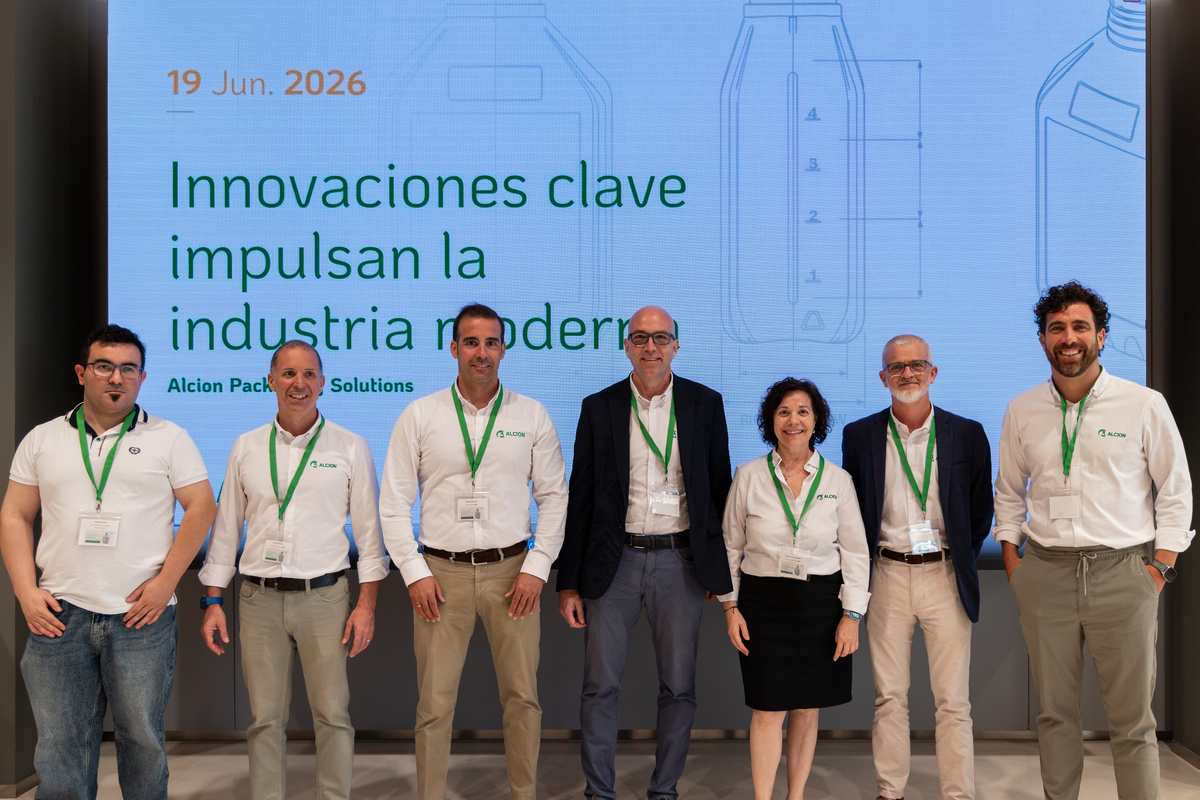
APS’ 5th Open House, held in Valencia on 19 June, once again established itself as a leading forum for the exchange of knowledge and expertise in the rigid industrial packaging sector.
During this fifth edition, customers, technology partners and industry professionals came together to discuss the main trends that will shape the future of industrial packaging, with a particular focus on innovation, sustainability and regulatory compliance.
In addition to showcasing new technologies, the event highlighted the importance of collaboration between manufacturers and technology providers and industry stakeholders in developing solutions that address real market requirements.
The presentations provided first-hand insight into advances in materials, plastic processing technologies, manufacturing processes and application systems that are already transforming the market.
Discover all the highlights from the event below.
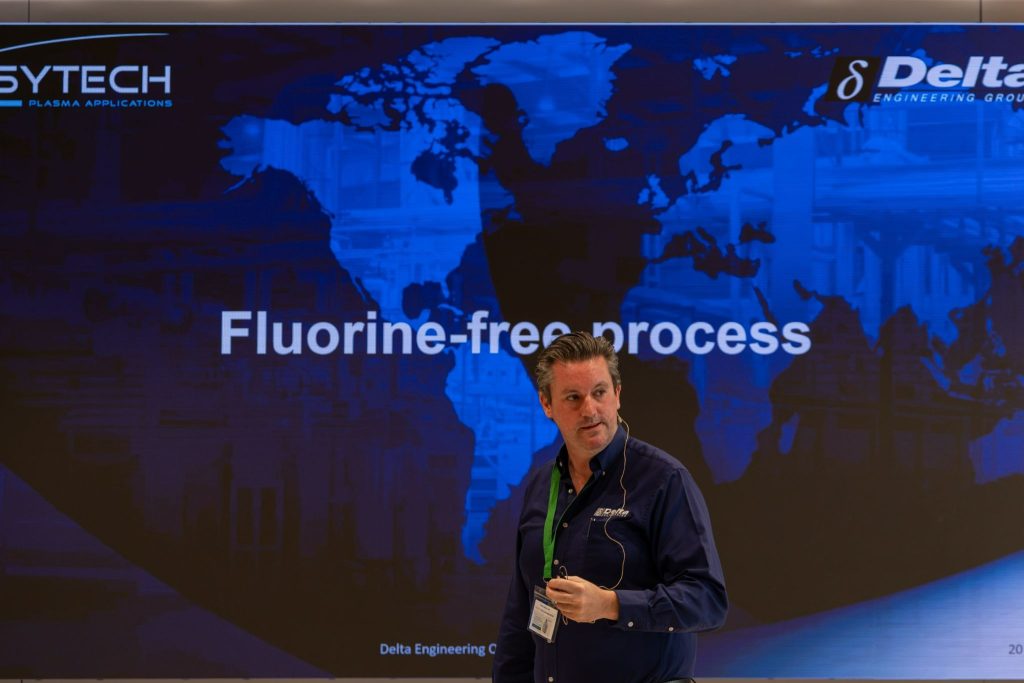
One of the event’s major innovations was presented by Steve Steenhoudt from Delta Engineering, whose session addressed one of the topics currently attracting the greatest interest in the packaging industry.
He introduced the development of plasma treatment solutions for the manufacture of high chemical-barrier packaging without PFAS.
During his presentation, Steenhoudt explained how plasma treatment technology uses electromagnetic energy under low-pressure conditions to create an ultra-thin barrier coating on the internal surface of the container.
This process significantly improves the container’s barrier properties without relying on fluorination processes involving PFAS related substances.
In addition to its environmental benefits, the technology can be integrated into existing production lines or to a retrofit solution for currente equipment, , enabling manufacturers to make a gradual transition towards more sustainable solutions.
The presentation highlighted that the challenge is no longer limited to developing packaging with better technical performance. It is also about using technologies that can anticipate regulatory changes and respond to new market demands.
In this context, APS has the expertise required to interpret regulatory developments and translate them into viable industrial solutions, helping customers prepare for an increasingly demanding business environment.
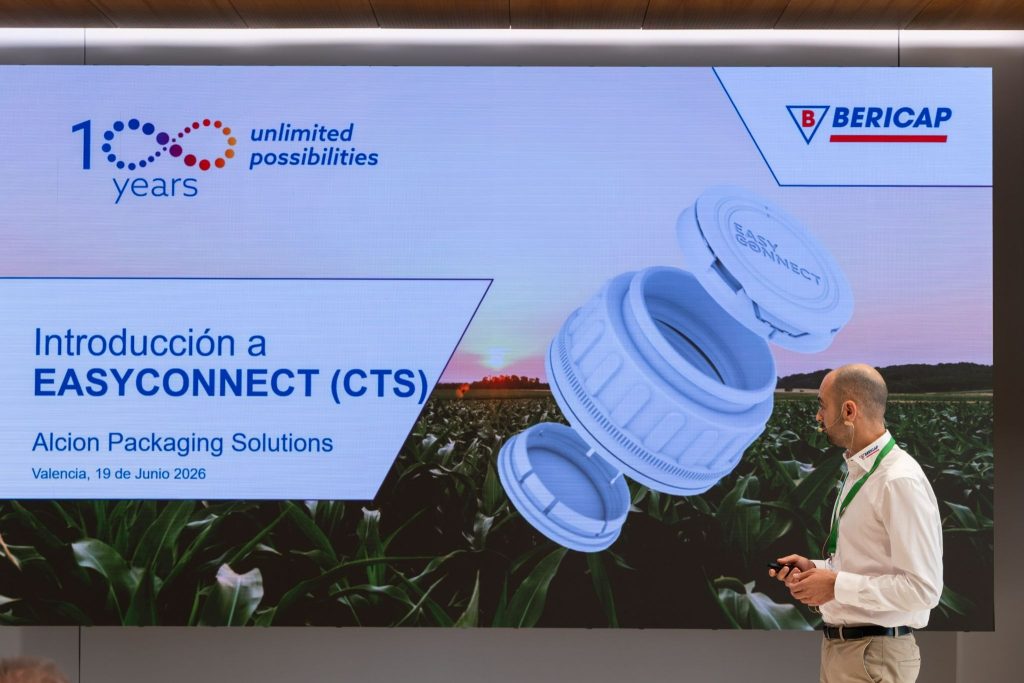
The second presentation was delivered by Carlos Blanco, International Key Account Manager at BERICAP.
Blanco explained how packaging has evolved from being a merely container to becoming an active component of the closed transfer and dispensing system.
In this context, EasyConnect is an innovation that redefines the handling and application of plant protection products.
During the session, he explained that EasyConnect should be understood as a Closed Transfer System (CTS), in which the container becomes an active element within the product application process.
The system allows the container to be connected directly to the spraying equipment through a secure, leak-tight coupling. This prevents operators from coming into direct contact with the chemical product and significantly reduces the risk of spills.
The solution improves handling safety and speeds up tank filling, while also enabling more accurate dosing than traditional methods.
One of the main points highlighted during the presentation was the importance of packaging design in ensuring the system performance.
EasyConnect is not simply about adding a new cap and coupler. It represents a complete evolution of the application system, in which the container, closure and equipment work together to deliver a safer, more efficient and more sustainable process.
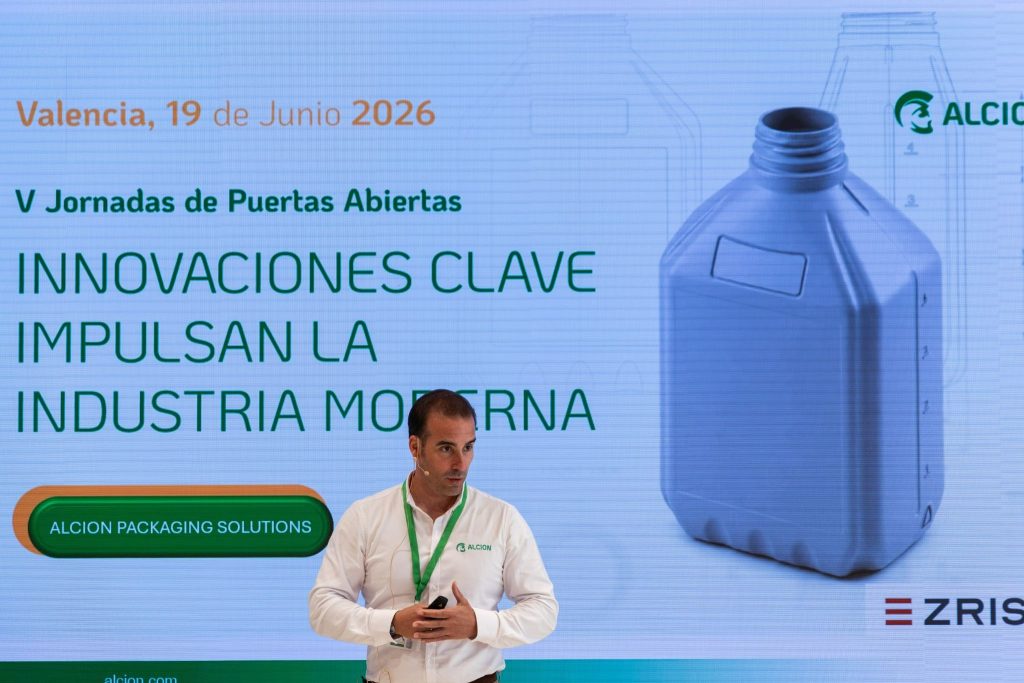
Miguel Navarro from APS connected the two previous presentations and demonstrated that innovation only creates genuine value when it can be transformed into industrial solutions that are ready to reach the market.
During his presentation, Navarro explained APS’ innovation model, which is based on continuous collaboration with customers, technology partners and research centres.
This collaborative network is supported by the ongoing analysis of market trends and future regulatory requirements. As a result, the company can identify opportunities before they develop into established market needs.
Based on this knowledge, APS follows a process of technology adoption, adaptation, validation and industrial scale-up. This enables new technologies to be transformed into products that are ready for large-scale manufacturing.
One of the initiatives presented was the APILA Project, which reflects this working model through the development of stackable and fully recyclable rigid industrial packaging with a high-barrier , achieved using PFA’s free plasma technology.
The project demonstrates that sustainability, functionality and technical performance can be integrated into a single packaging solution.
The presentation also covered APS’ work on the EasyConnect system.
The company presented studies analysing the performance of APS’ standard containers when combined with EasyConnect closures, as well as the development of new containers with a centrally positioned neck designed from the outset to be compatible with the system.
These projects demonstrate an approach to innovation based on continuous improvement and the ability to adapt industrial packaging to the emerging requirements of the sectors APS serves.
APS’ 5th Open House reflects the company’s commitment to innovation focused on real market needs.
Technologies such as PFA’s free plasma treatment, closed transfer systems such as EasyConnect, and development initiatives such as the APILA Project are all examples of a strategy built around anticipation, efficiency, collaboration and continuous improvement.
APS will continue to promote initiatives that encourage the exchange of knowledge with customers and partners. The company firmly believes that the industry’s greatest advances are driven by collaboration and by the ability to transform emerging trends into practical, scalable industrial solutions.
To learn more about our latest developments and upcoming APS initiatives, follow us on social media or contact our team.
We will be delighted to share the solutions that are helping to define the future of rigid industrial packaging.
And, of course, we invite you to join us for the next edition of APS’ Open House!

Plasma technology creates a high-performance barrier layer on the inner surface of a container without the need to use fluorinated compounds.
Its main benefits include:
PFA’s, or Per- and Polyfluoroalkyl substances, are chemical compounds that have traditionally been used to improve certain barrier properties.
However, growing environmental and regulatory concerns are driving the development of more sustainable alternatives.
Industrial packaging manufacturers are therefore working on solutions that can deliver comparable technical performance while avoiding the generation of these substances during production processes and anticipating changes in market regulations.
A high chemical barrier can be achieved using different technologies, including multilayer structures, specialised coatings and advanced plasma treatments.
The objective is to reduce the permeation of the packaged product and preserve the safety, stability and effectiveness of sensitive substances.
The most appropriate technology will depend on factors such as the product’s chemical composition, regulatory requirements, and the logistical conditions involved in storage and transport.
Discover more: Shaping the future at the IV APS' Open House Days
A Closed Transfer System (CTS) is designed to transfer formulated crop protection products from a container to the application equipment while minimising operator exposure and preventing spills.
Systems such as EasyConnect create a secure, leak-tight connection between the container and the sprayer.
This improves workplace safety, dosing accuracy and operational efficiency, while helping companies comply with increasingly demanding regulatory requirements.
The performance of a Closed Transfer System does not depend solely on the cap or coupler.
The geometry of the container, its stability during emptying, the position of its neck and its dimensional compatibility with CTS equipment are all essential factors in ensuring a safe and efficient transfer process.
For this reason, APS is developing new industrial packaging solutions that incorporate specific design requirements from the earliest stages of product development, optimising the performance of CTS solutions such as EasyConnect.
Innovation in industrial packaging currently aims to integrate sustainability and performance requirements within the same solution.
This involves developing recyclable containers, optimising material use, improving stackability to reduce the logistics footprint and applying advanced barrier technologies that maintain product protection.
Projects such as APILA demonstrate that operational efficiency, circular economy principles and high technical performance can all be combined in a single packaging solution.
The APILA Project is an innovation initiative designed to demonstrate that three key characteristics required by modern industry can be incorporated into a single container:
The project combines packaging designs optimised for logistics efficiency with advanced barrier technologies, including PFA’s free plasma treatments.
Its objective is to develop industrial packaging solutions that reduce environmental impact without compromising the technical performance required by sectors such as the agrochemical and crop protection industry.
Greater stackability optimises transport and storage, while the recyclability of the container supports circular economy principles.
At the same time, advanced barrier technologies ensure that the packaged product remains protected throughout its useful life.
APILA also represents APS’ innovation model: identifying emerging trends, collaborating with technology partners and transforming new technologies into scalable, market-ready industrial solutions.