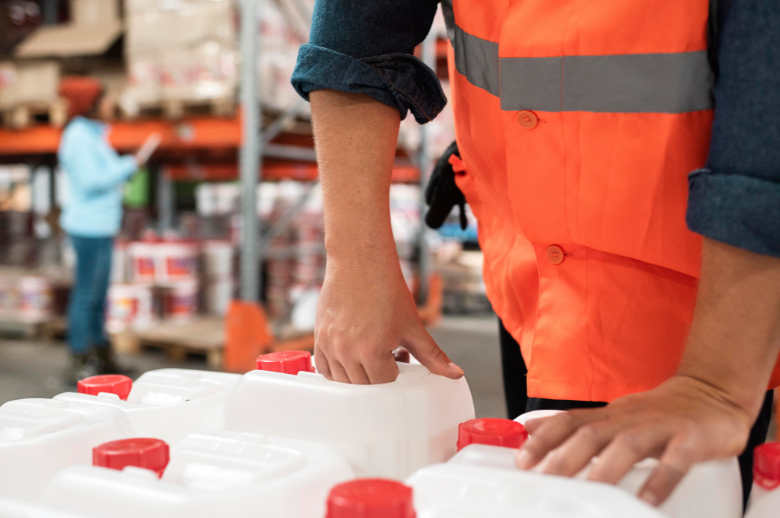
Chemicals transport remains one of the major operational challenges in industrial environments.
Managing large volumes of chemical substances, many of them hazardous substances, requires oing so safely, efficiently, and in compliance with increasingly demanding regulations.
Limited space, spill and leak risks, issues related to chemical compatibility and poor internal logistics can drive up costs and compromise the safety of both people and facilities.
Against this backdrop, having a robust storage strategy, and suitable industrial container and industrial packaging designed to maximize safety and logistical efficiency, becomes essential.
This article explores the main challenges in the storage of chemicals and shows how large-capacity solutions and stackable drums can become strategic solutions to optimise processes, space, and chemical safety, also improving overall chemical transport performance.
In the chemical industry, day-to-day handling of chemical substances requires rigorous control.
Poor management of the storage of chemicals can result in leaks, cross-contamination, workplace accidents, or even non-compliance with legislation..
Very often, these problems arise fromlimited space, saturated warehouses, and/orinefficient logistic flows that increase the likelihood of spills or operational errors.
To avoid such risks, chemical storage should be approached taking into account three pillars:
Keep learning: The evolution of packaging: PET plastic bottles and the future of industrial containers with advanced technologies
Chemicals transport presents specific challenges that do not usually apply to other types of goods. Let’s look at the most relevant ones.
One of the major risks lies in ensuring a correct chemical compatibility. Some products must not be stored together because dangerous reactions may occur in the event of leaks or accidental contact.
That’s why correct segregation of hazardous substances is essential to prevent serious incidents.
Proper segregation of hazardous substances is therefore essential to prevent serious incidents. Achieving this requires identifying each product, understanding its properties, and relying on key documentation such as the Safety Data Sheet (SDS/MSDS), which indicates storage conditions, incompatibilities, and the necessary safety measures.
You may also be interested in:What is paneling in a plastic container?
Another common challenge is the optimisation of available space.
With the increasing use of Just-in-Time material management, many industrial warehouses have reduced storage capacity and the existing space often operates at its limit, making circulation difficult and limiting access to products, complicating stock organisation.
Poor warehouse layout affect logistical efficiency: slows operations and increases the risk of errors or accidents.
In this context, choosing the right solution, especially the right industrial container, plays a decisive role in optimising chemicals transport and the entire internal logistic chain.
An effective way to improve warehouse storage capacity is through the use of large-capacity industrial containers.
They have become a key solution for improving the storage of chemicals and internal logistics, enabling a more rational warehouse organisation.
Large-capacity solutions offer strategic advantages by reducing the number of units stored, enabling a significant optimisation of available space.
By consolidating greater volumes into fewer containers, warehouse organization improves and minimises loading, unloading, and replenishment times. Besides, it also supports more efficient inventory management and logistics optimization, reducing unnecessary movements both in storage and chemical transport operations.
Stackable drums provide an additional benefit: they allow vertical optimisation of space in a safe and stable manner.
Designed to ensure safe stacking, strength, and easy handling, this type of drum helps organize the warehouse, improves product identification, and reduces operational risks, supporting both safer storage and more efficient chemical transport.
In chemical storage, packaging acts as a critical safety barrier.
Chemical safety for potentially hazardous products plays a crucial role in industrial environments and must be handled with maximum attention.
How can this be achieved? Here are the key points.
Plastic industrial packaging used in the chemical industry must guarantee high levels of leak tightness and chemical resistance.
This prevents leaks, evaporation, or external contamination that could compromise the safety of both personnel and the environment.
These solutions are also designed to withstand demanding storage and chemical transport conditions, such as temperature fluctuations, impacts, and vibrations, keeping the integrity of chemical substances throughout the entire logistical cycle.
The Safety Data Sheet (SDS/MSDS) is an essential tool for proper storage management.
It provides product characteristics, incompatibilities, ventilation requirements, stacking conditions, and emergency procedures.
Integrating the SDS/MSDS into chemical storage procedures supports informed decisions about product placement, the most suitable industrial container, and the required protective measures, strengthening chemical safety and regulatory compliance.
Optimising the storage of chemicals requires a combination of technical expertise, regulatory compliance, and the right packaging solutions.
At APS, we support industrial companies throughout this process, offering specialized guidance and industrial packaging designed to maximize safety, logistical efficiency, and warehouse space utilisation.
Our experience with large-capacity containers, stackable drums, and chemical logistics solutions allows our clients to reduce risks through safe storage and optimised processes, all aligned with market demands and current regulations.
Want to learn more? Contact us and we’ll advise you.